Countertop water purifiers
AquaTru vs Sans: two data sheets, and only one of them says certified
Both are countertop reverse osmosis machines with published lab numbers. The difference is who checked the work, and for how long.
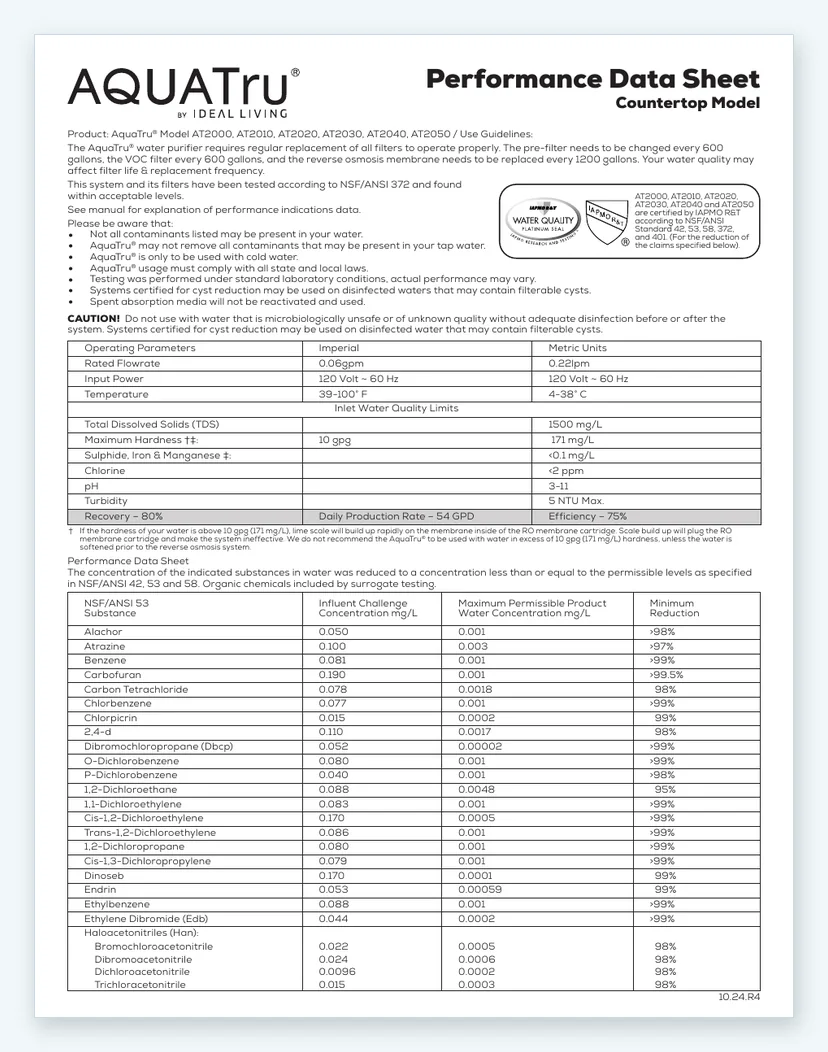
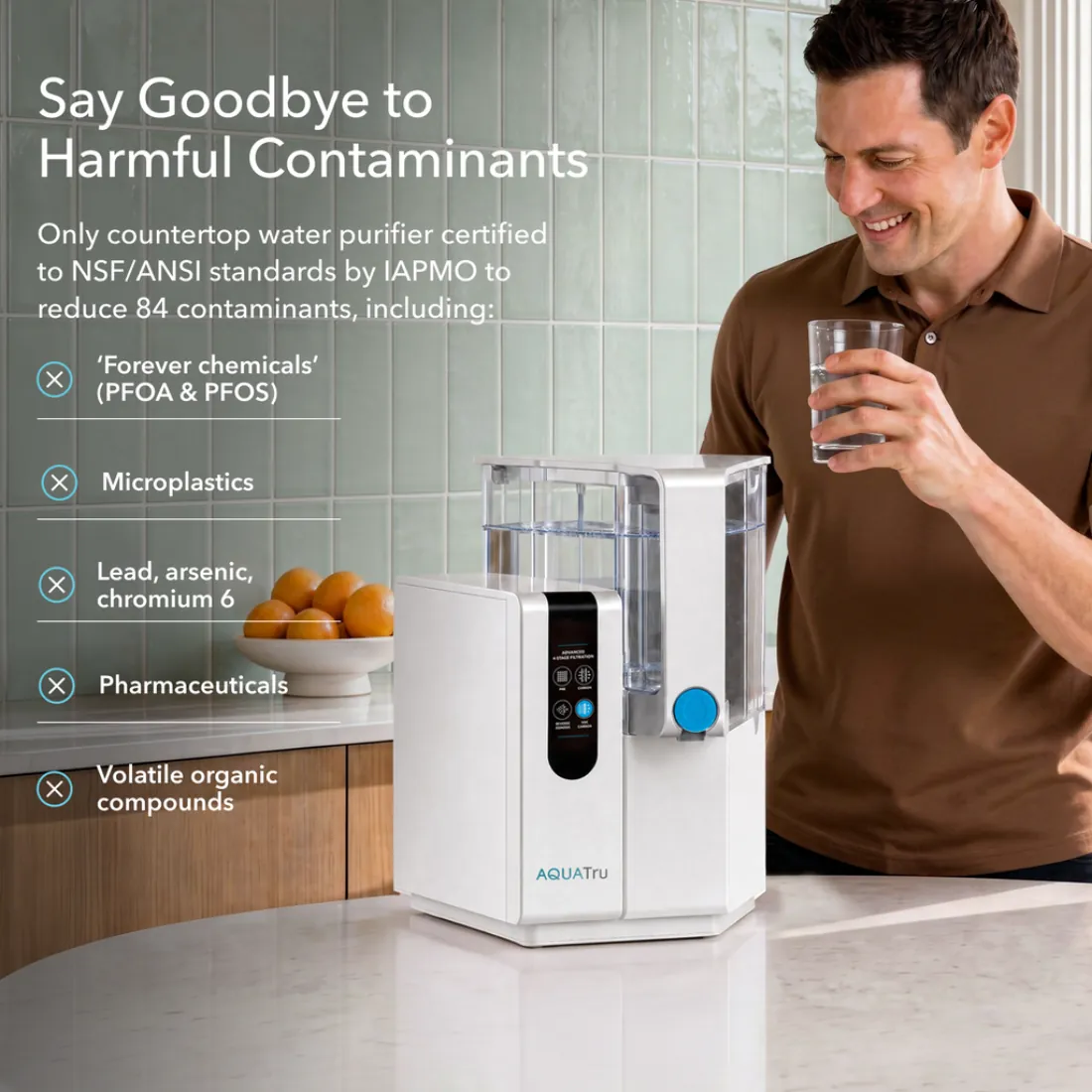
certified by IAPMO R&T according to NSF/ANSI Standard 42, 53, 58, 372, and 401
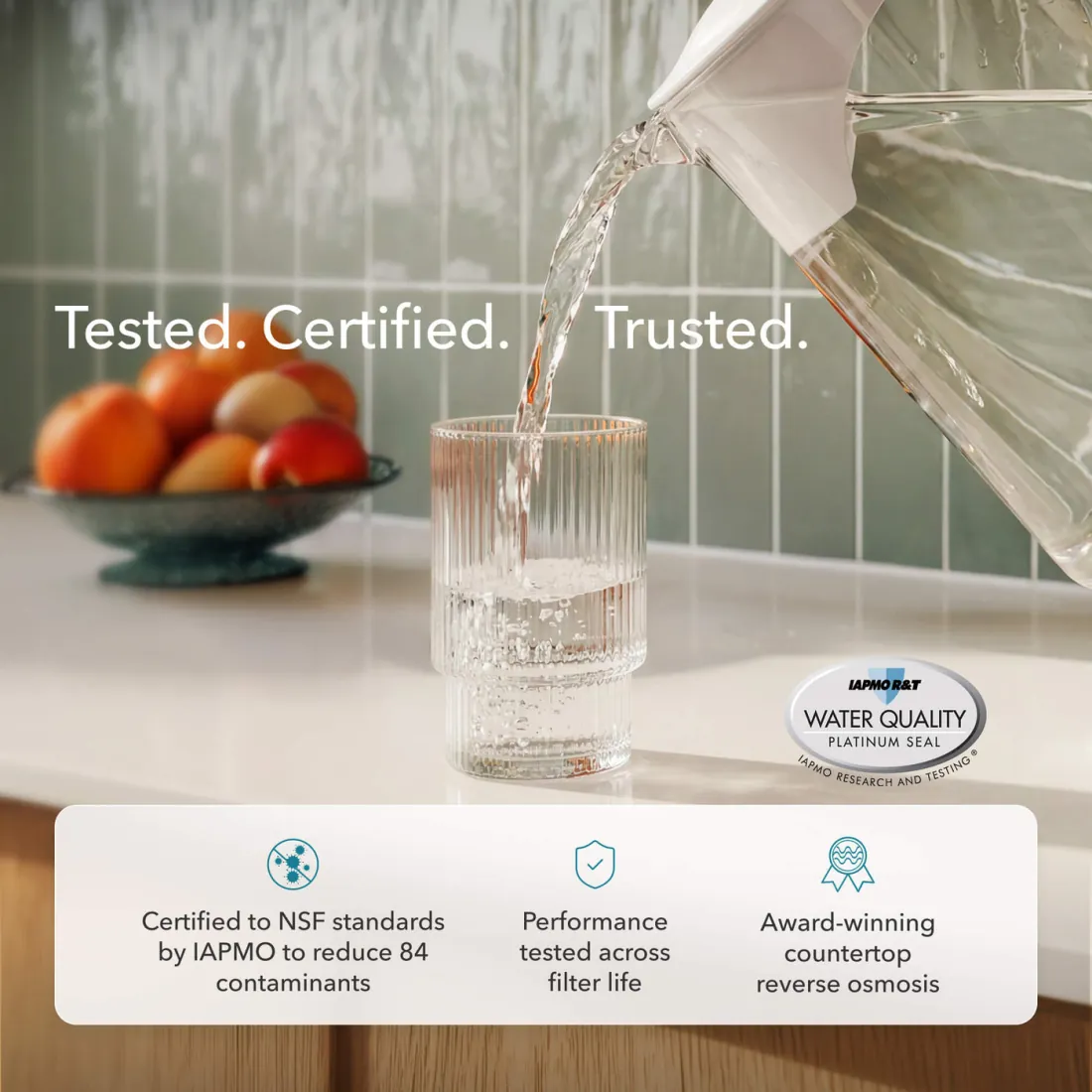
84 contaminants, verified by an accredited certification body.
AquaTru countertop Performance Data Sheet, published on aquatru.com
The Sans Water Purifier is not NSF-certified.
Claims based on independent laboratory testing performed by SGS, an ISO/IEC 17025-accredited lab.
Sans Water Purifier Performance Data Sheet, published on livesans.com
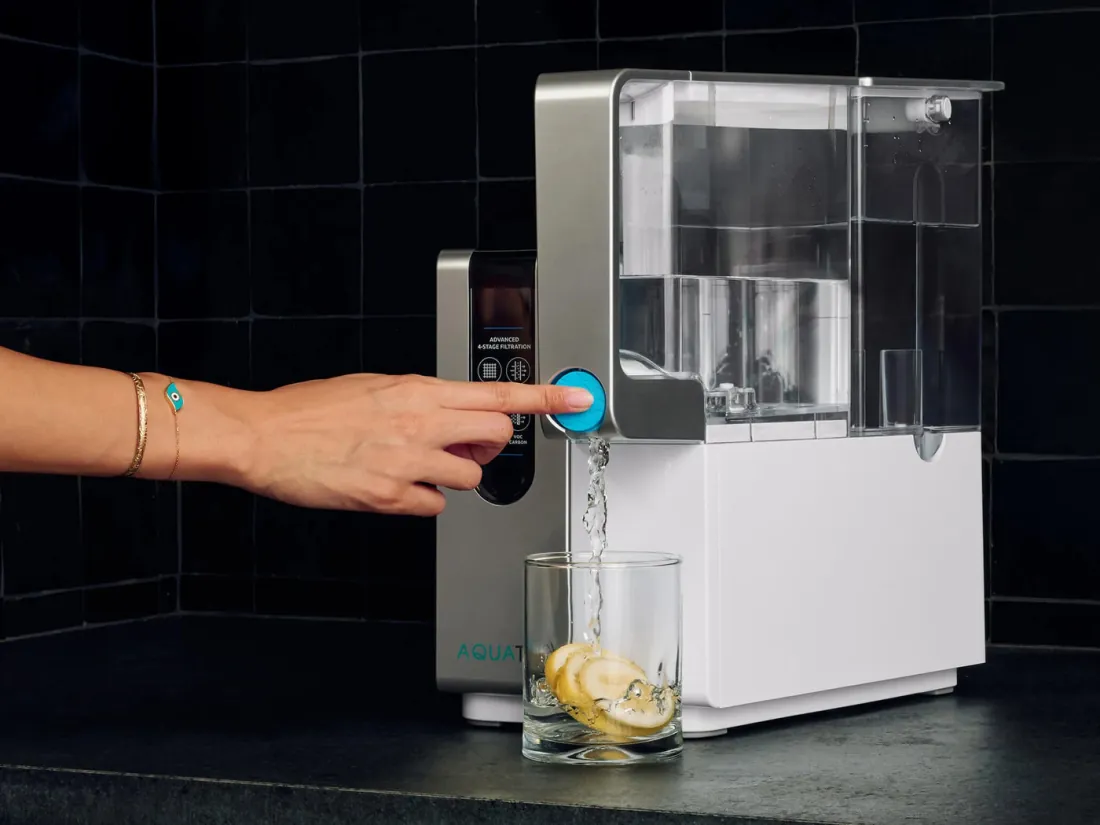
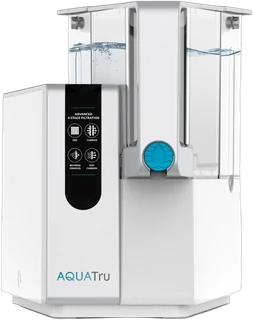
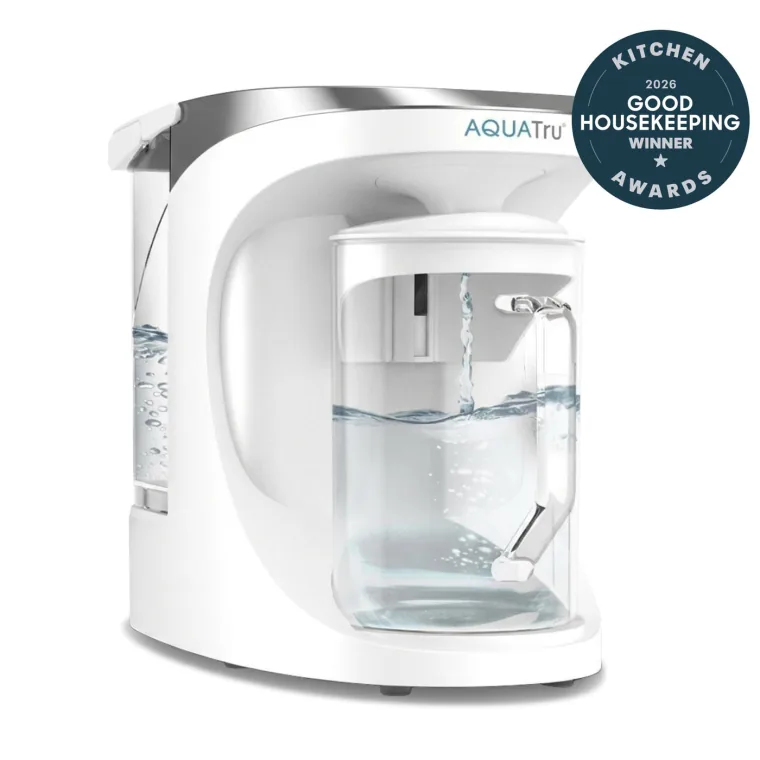
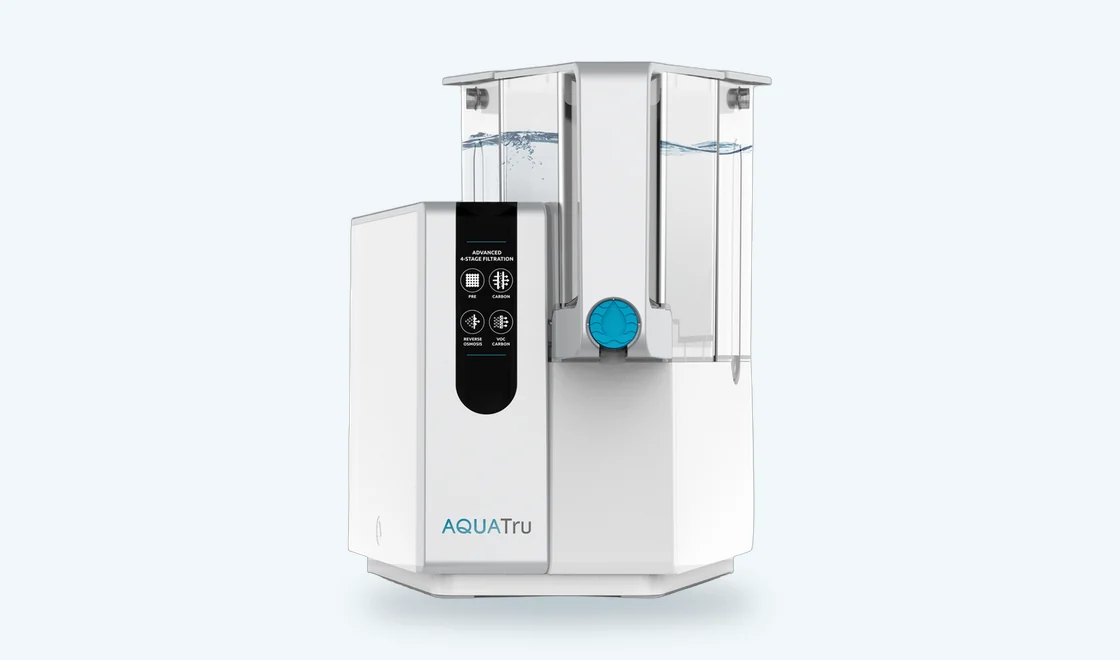
Machine photo: aquatru.com.
If you are choosing between these two machines you have probably already read a head to head. Most of them run the same six categories: price, filters, design, features, customer experience, warranty. On five of those six the answer is genuinely close, and several of them go to Sans. This page adds the category the others leave out, and gives you the tools to check every line of it yourself.
Nothing below is an opinion about either company. Every number about AquaTru comes from aquatru.com. Every number about Sans comes from livesans.com. Where Sans is the better buy, it says so.
Part 1The two machines are more alike than the marketing suggests
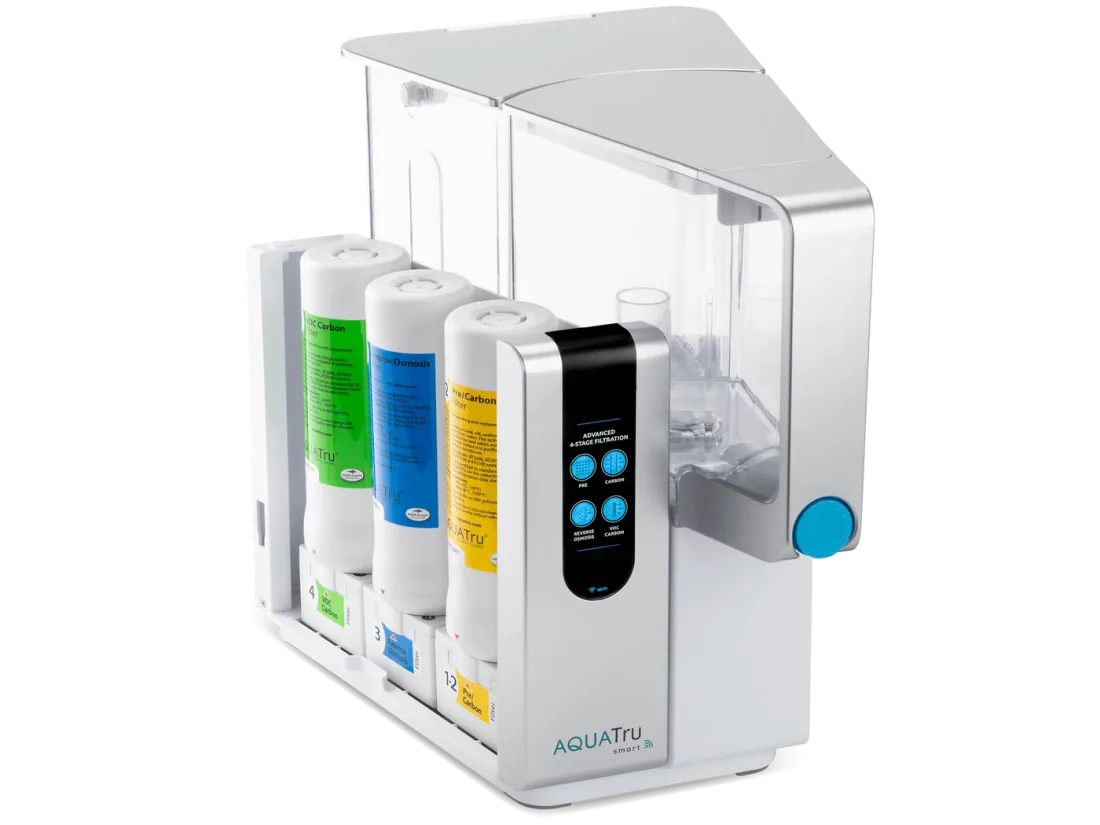
Both are countertop reverse osmosis systems that need a wall socket and no plumbing. Both use a three cartridge stack with the same three names: a pre/carbon filter, a reverse osmosis membrane, and a VOC carbon filter. Two of those three cartridges are rated identically on both machines, down to the gallon. Both offer a 30 day money back window.
Reverse osmosis is the reason either of them is worth considering. A pitcher filter is activated carbon: it handles chlorine, sediment and taste. An RO membrane works at a scale small enough to hold back dissolved metals, nitrate and fluoride, which carbon does not touch. On that principle, the two companies agree completely.
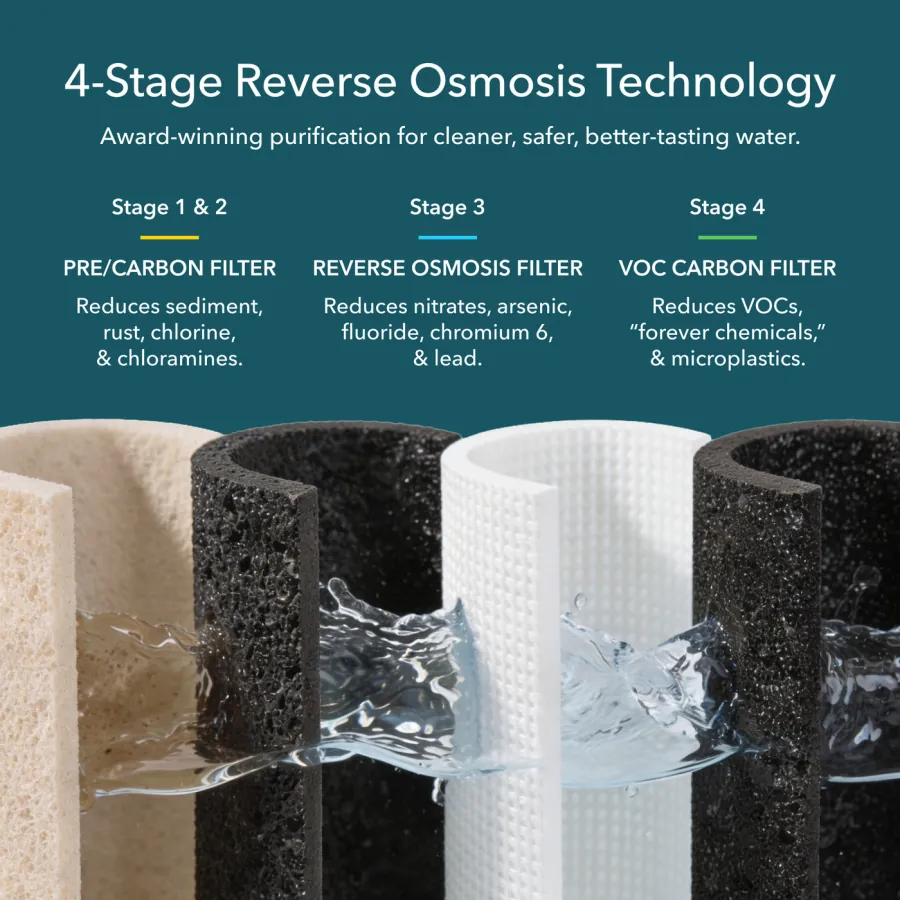
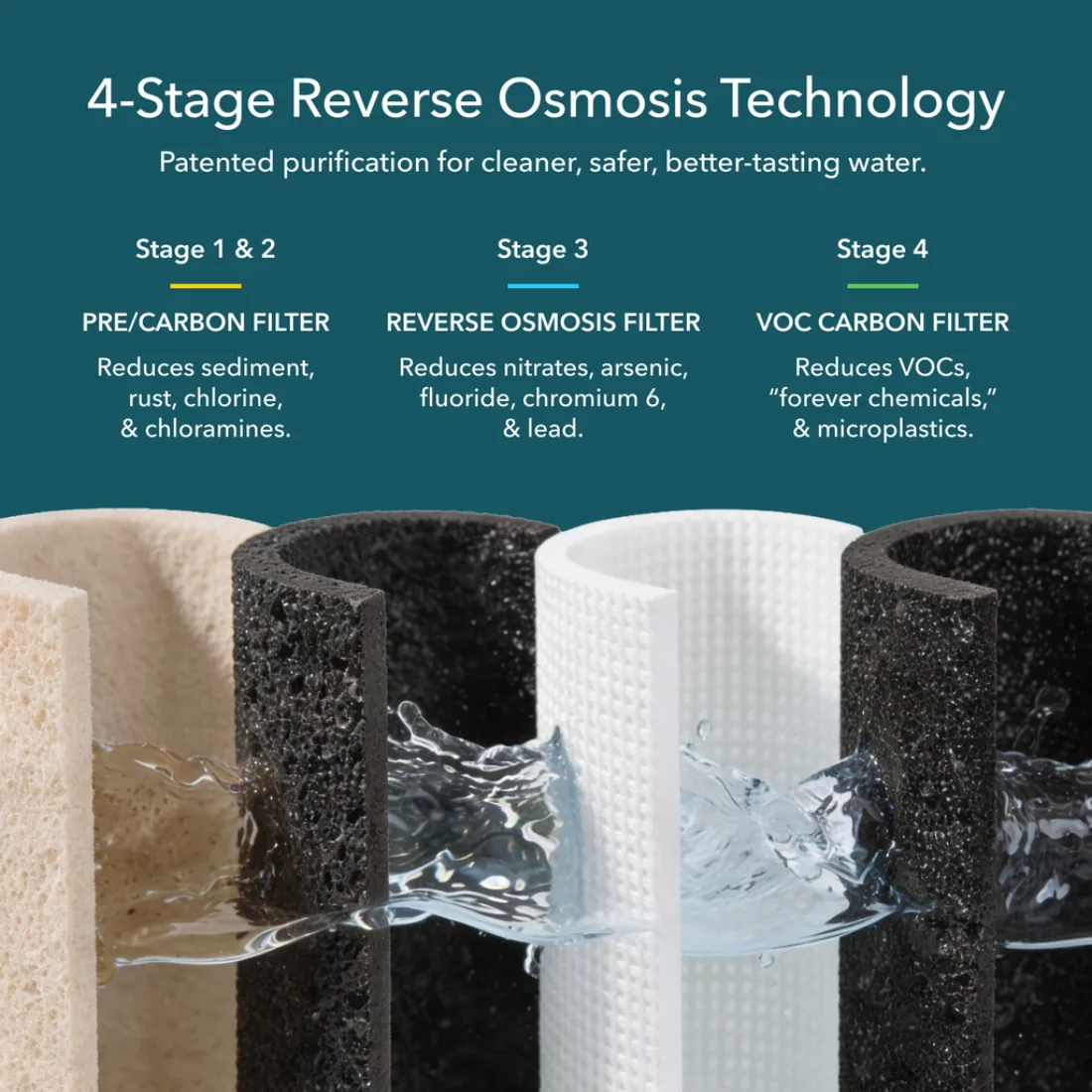
AquaTru’s 4-Stage Reverse Osmosis Technology
Stage 1 & 2
Pre/Carbon filter
Reduces sediment, rust, chlorine, & chloramines.
Stage 3
Reverse osmosis filter
Reduces nitrates, arsenic, fluoride, chromium 6, & lead.
Stage 4
VOC carbon filter
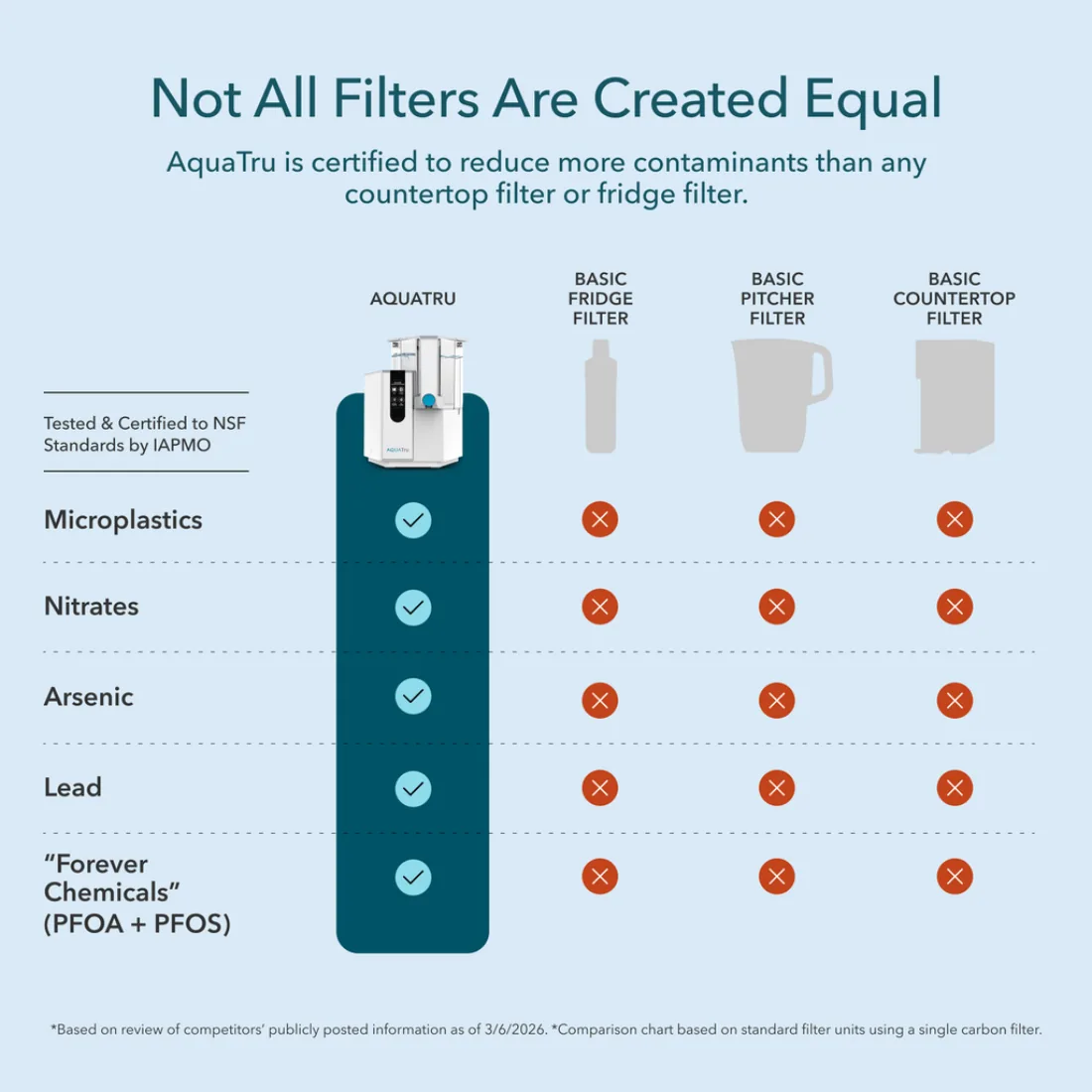
Reduces VOCs, “forever chemicals,” & microplastics.
Stage numbering, stage names and stage descriptions as published by AquaTru on aquatru.com.
One thing to settle before any price comparison: AquaTru sells more than one countertop machine, and they are not in the same position. Comparisons tend to pick the AquaTru Carafe because it is the closest in size and the cheapest. That choice changes the answer, for a reason we come back to at the end.
| Countertop model | Price today | Certification status |
|---|---|---|
| AquaTru Carafe | $375 | Tested by IAPMO, certification pending |
| AquaTru Classic | $475 | Certified by IAPMO R&T |
| AquaTru Classic Smart | $525 | Certified by IAPMO R&T |
| Sans Water Purifier | $399.99 | Tested by SGS, not NSF-certified |
AquaTru prices and certification status as published on aquatru.com on August 12, 2026. Sans price and certification status as published on livesans.com and in the Sans Performance Data Sheet on the same date. Sans lists $399.99 as a promotional price against a regular price of $499.99.
Part 2Start where a buyer starts: the percentages
Both companies publish a reduction figure for each contaminant they tested. Here they are next to each other, restricted to the contaminants that appear on both documents.
| Contaminant | AquaTru Classic, certified average reduction | Sans, published removal rate |
|---|---|---|
| Lead | 99.1% | >99.3% |
| Arsenic (pentavalent) | 98.0% | >97.2% |
| Hexavalent chromium | 97.2% | 98.6% |
| Fluoride | 93.5% | >99.9% |
| Nitrate (as N) | 87.2% | >99.9% |
| Total dissolved solids | 87.1% | >98.6% |
| Copper | 95.2% | >99.6% |
| Barium | 96.4% | >99.9% |
| Selenium | 98.1% | >95% |
| PFOA and PFOS | 97.5% | >98.8% / >99% |
| Microplastics, 0.5 to 1 micron | 96.48% | 99.9% |
AquaTru figures are the average reduction column of its certified countertop Performance Data Sheet, except PFOA and PFOS which the sheet states as a minimum reduction under NSF/ANSI 53. Sans figures are the removal rate column of its Performance Data Sheet. Both documents are linked at the end of this page.
Read that table cold and Sans wins nine of the eleven rows. That is not a typo and it is not a trap. If a percentage were a percentage, the comparison would be over and this page would be short.
It is not, and the reason is in a column neither company puts in its marketing.
A reduction percentage is a percentage of something
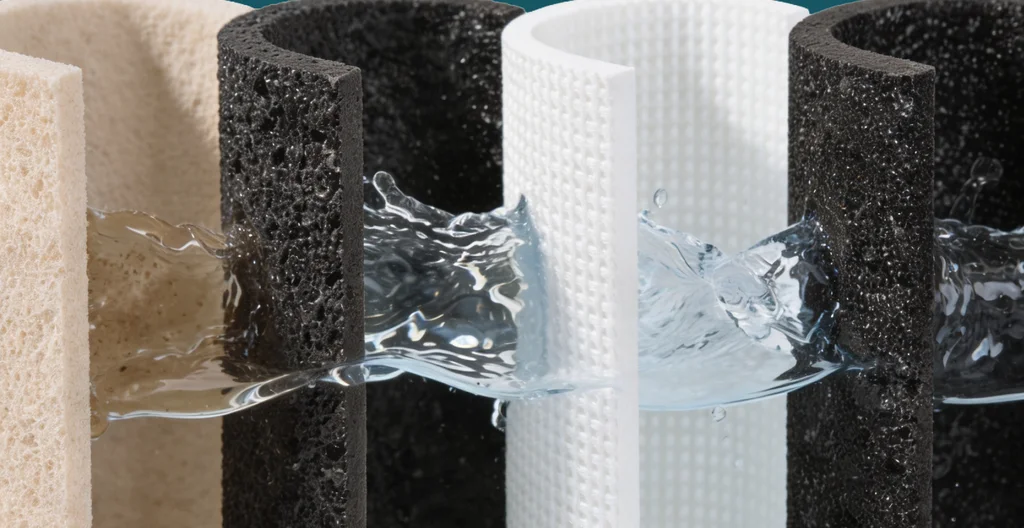
Every reduction figure is the answer to a subtraction. You start with water at a known contamination level, you run it through, you measure what comes out. Change the water you start with and the same machine produces a different percentage.
That starting level is called the influent challenge, and both sheets publish it. Here is what each machine was actually asked to do.
The water each test started with
Influent challenge concentration, as published on each company's own data sheet. Bars are relative within each contaminant.
Lead
Total dissolved solids
Fluoride
Nitrate, as N
Arsenic (pentavalent)
On lead, dissolved solids and fluoride the two tests started from almost the same water, so those rows are close to comparable. On nitrate and especially on arsenic, Sans was working from a dirtier sample, which makes its result on those lines harder to obtain, not easier.
That is a point for Sans, and it is worth saying plainly. The arsenic challenge on their sheet is seven times the concentration the NSF protocol specifies, and they still published a reduction above 97 percent. A comparison that skipped the influent column would have handed you the opposite impression.
So the percentages are not the problem. The question is what happens to those percentages after the report is filed.
Part 4Tested, and certified
This is the distinction the whole category turns on, and AquaTru states it in one line on its own site:
Testing simply means a product was evaluated. Certification means an independent, accredited organization has verified that the product meets established performance standards. AquaTru, aquatru.com
In the United States, four organizations can certify a drinking water product to NSF/ANSI standards: NSF, IAPMO, WQA and UL. AquaTru names all four on its FAQ page, along with the part that matters most to somebody who will own the machine for a decade:
When you get tested and certified with one of these labs, they test the filter to the end of life to ensure that it performs just as well on the last gallon of water filtered as the first gallon filtered. AquaTru, aquatru.com FAQ
A laboratory report is a photograph. A certification is a contract that keeps running. The AquaTru data sheet spells out what the contract obliges the manufacturer to do after the certificate is issued: re-test the product every five years for material safety, structural integrity and every performance claim made, and submit any change to the product to the certification agency for technical review and approval before implementing it.
Sans publishes a real test from a real laboratory. SGS is ISO/IEC 17025 accredited, which is the accreditation that says a lab is competent to run the methods it claims. The sheet gives the testing period as December 2023 to March 2024, and it does not describe an end of life protocol. It also carries the sentence at the top of this page, in Sans's own words: the machine is not NSF-certified.
What happens after the report is published
Drawn from the obligations each document states on its own face.
Certified product
- Accredited body sets the protocol. Standardised influent, standardized pass criteria, not chosen by the manufacturer.
- Filter is run to the end of its rated life. The claim has to hold on the last gallon, not only the first.
- Listing is public. Anyone can look the product up in the certifier's directory.
- Any change to the product goes back to the certifier for review and approval before it ships.
- Re-tested every five years for material safety, structural integrity and every claim made.
Tested product
- Manufacturer commissions the test and selects the laboratory, the methods and the sample.
- Accredited laboratory runs it. SGS holds ISO/IEC 17025, so the measurement itself is competent work.
- Report covers a period. On the Sans sheet, December 2023 to March 2024.
- Nothing further is stated. No end of life protocol, no public listing, no re-test interval, no change approval on the document.
Neither column is an accusation. They are two different instruments, and they answer two different questions. One tells you what a machine did in a laboratory. The other tells you what a machine has to keep doing.
What is actually on each list
The second thing certification buys is breadth. AquaTru's countertop certification covers five standards at once, and each standard brings its own list of substances. Sans's data sheet covers nineteen test items.
Contaminants on each document
Not a scorecard. A map of where each document has something to say and where it is silent.
On AquaTru's certification, absent from Sans's sheet
84 certified
- Around fifty organic chemicals under NSF/ANSI 53: atrazine, benzene, lindane, trichloroethylene, tetrachloroethylene, the trihalomethane group, haloacetonitriles and the rest of the disinfection by-products
- Fifteen emerging contaminants under NSF/ANSI 401: ibuprofen, naproxen, carbamazepine, atenolol, trimethoprim, estrone, bisphenol A, DEET, the flame retardants TCEP and TCPP
- Cysts, including Giardia and Cryptosporidium, at 99.99%
- Radium 226/228, perchlorate, chloramine
- Lead-free material safety, tested under NSF/ANSI 372
On Sans's sheet, absent from AquaTru's
19 tested
- Total coliform, at 99.9999%
- MS2 coliphage, a virus surrogate, at 99.99922%
- Mercury, at more than 90.9%
- Chlorate, at more than 99.8%
Why that matters
- Sans adds a UV-C stage that AquaTru's countertop line does not have, and it publishes bacteria and virus data to go with it
- Both machines carry the same caution: neither is intended for water that is microbiologically unsafe without separate disinfection
Read the two columns together rather than as a score. If your concern is pesticide runoff, industrial solvents or pharmaceutical residue, only one document has anything to say. If your concern is bacteria, only the other one does.
Microplastics, since both machines claim them
This is the single best illustration of the difference, because both companies tested the same particle size and reported a strong result.
Sans
99.9%
Method ASTM D5127-13, particles at 0.5 micron. Challenge 27,139,333, effluent 1,694. The unit is not stated on the sheet.
AquaTru Classic
96.48%
NSF/ANSI 401, particles 0.5 to under 1 micron. Pass mark 85%, challenge 1,400,000 particles per milliliter. Certified, not only tested.
Sans reports the higher number. AquaTru reports a number an accredited body signed, against a pass mark written by a standards committee, on a filter run to the end of its rated life. Those are two different kinds of fact about the same particle size, and picking between them is a judgment about what you want a number to mean, not about which company is telling the truth.
It is also a small lesson in reading these documents. Sans's microplastics row gives a challenge count without a unit, while AquaTru's states particles per milliliter. Neither sheet is hiding anything. But you cannot line the two rows up without noticing that, and that is exactly the habit worth taking into any spec comparison.
Part 7Where Sans is the better machine
A comparison that never concedes anything is not a comparison. These are the places where Sans is ahead, and on most of them it is not close.
The money, with the arithmetic shown
Filter pricing in this category is deliberately hard to compare, because the cartridges have different lives. The only honest way to do it is to put the price of each cartridge next to how long that cartridge is rated for.
| Item | AquaTru Classic | Sans Water Purifier |
|---|---|---|
| Machine | $475.00 | $399.99 |
| Pre/carbon filter | $29.95 6 months or 600 gal | $34.99 12 months or 600 gal |
| RO membrane | $59.95 24 months or 1,200 gal | $54.99 24 months or 1,200 gal |
| VOC carbon filter | $39.95 12 months or 600 gal | $34.99 12 months or 600 gal |
| One full replacement set | $129.85 | $124.97 |
| Annual plan sold by the brand | $79.95 one-year combo pack | $107 Clean Water Club, reg. $120 |
| Machine plus one full set | $604.85 | $524.96 |
Prices as published on aquatru.com and livesans.com on August 12, 2026. AquaTru's one-year combo pack contains two pre/carbon filters and one VOC carbon filter and does not include the RO membrane, which is rated for two years and is sold in the $189.95 two-year pack. Sans lists subscribe and save prices on its individual cartridges, which bring a full set to $112.47. Sans's Clean Water Club delivers all three cartridges every twelve months, while its own product pages rate the RO membrane at twenty-four.
Sans is cheaper. About $75 on the machine and about $5 on a full set of cartridges. AquaTru's own annual pack costs $27 less per year than Sans's subscription, which narrows the gap over time without closing it inside three years. If price is the deciding factor, the decision is already made and the rest of this page is background.
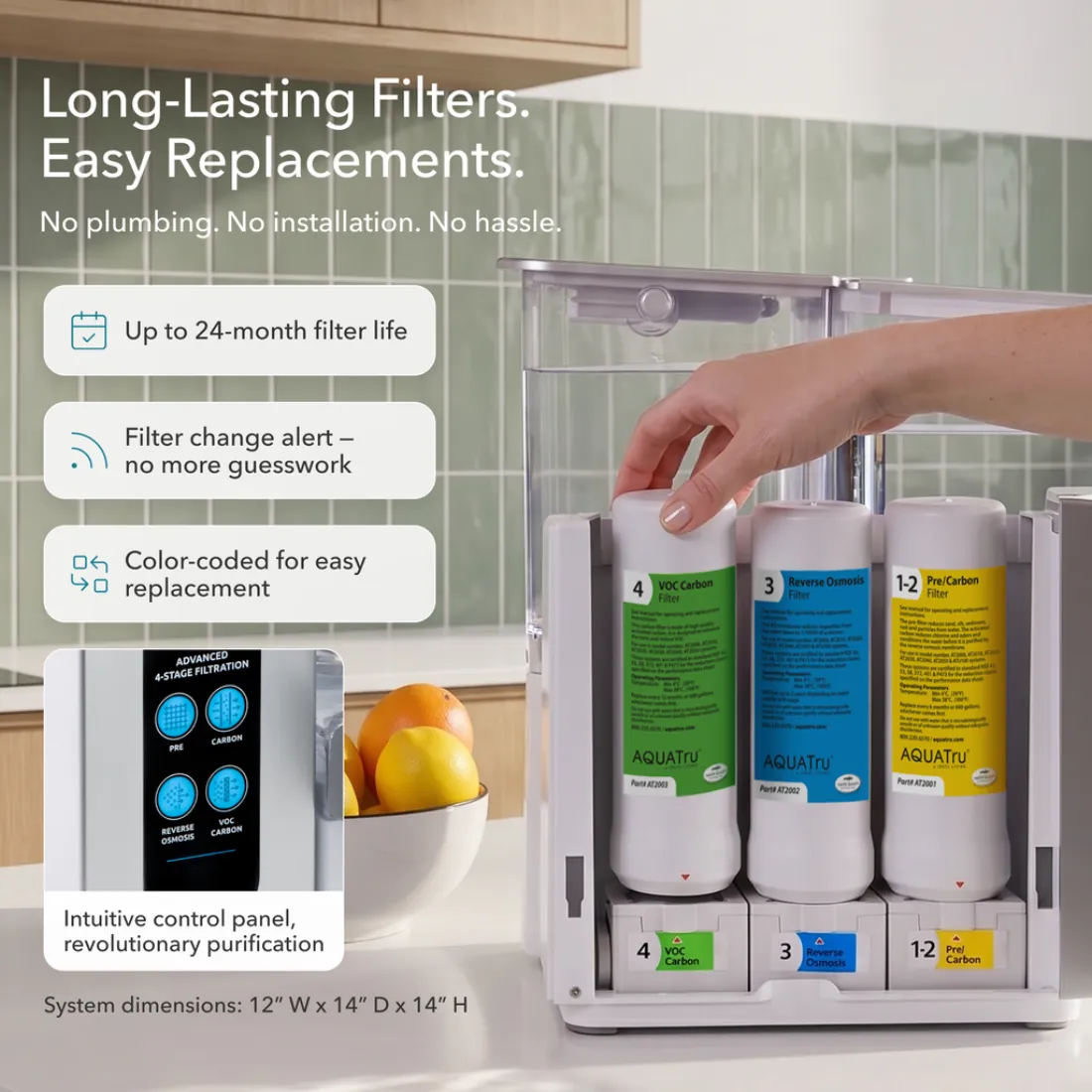
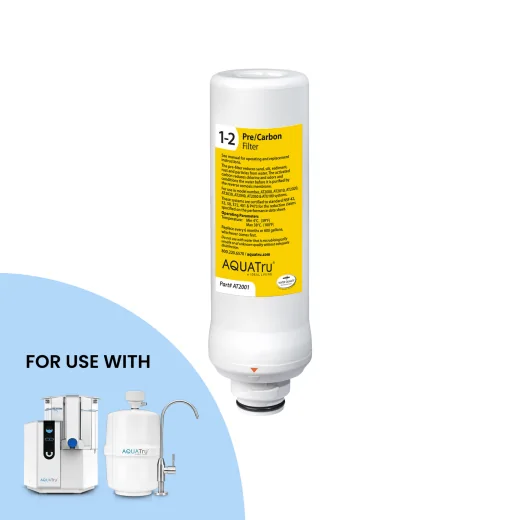
Pre/carbonSediment, rust, chlorine taste. 6 months or 600 gallons.
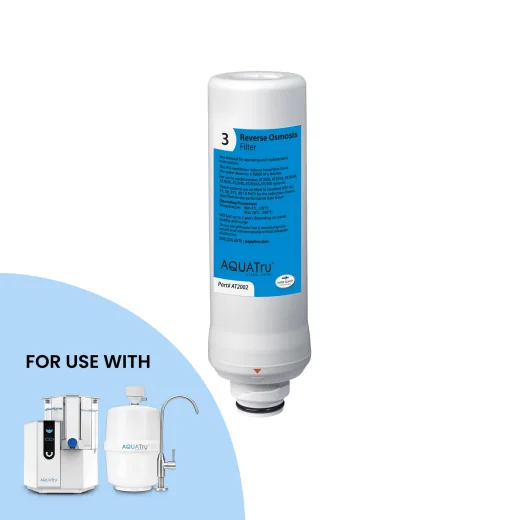
Reverse osmosisLead, arsenic, chromium 6, nitrate, copper. 24 months or 1,200 gallons.
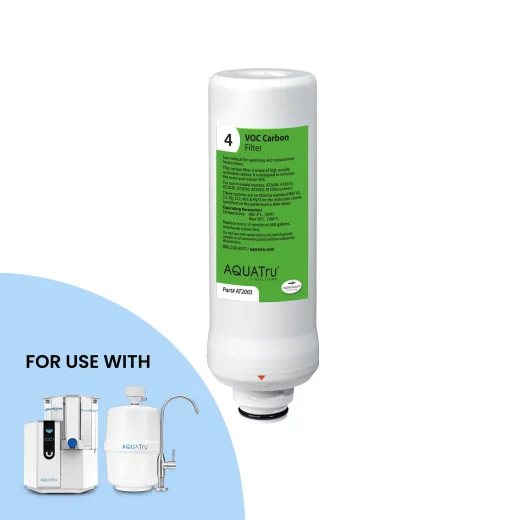
VOC carbonVolatile organic compounds, drug residues, PFOA and PFOS. 12 months or 600 gallons.
Stage descriptions and filter lives as published on aquatru.com. AquaTru rates the whole system at 54 gallons a day, with a 75 percent efficiency rate on the Classic, and does not recommend the machine on water harder than 10 grains per gallon without softening or regular descaling.
Part 9AquaTru's own asterisk, and why it changes the price comparison
If certification is the reason to choose AquaTru, then it matters a great deal which AquaTru you buy. The company is unusually direct about this on its FAQ page:
Seventy-eight contaminants have already passed testing and five contaminants are still undergoing testing. While this third-party testing has been conducted, IAPMO certification is still pending on this model. AquaTru, on the AquaTru Carafe, aquatru.com FAQ
The Carafe is the $375 machine. It is the one most head to head comparisons pick, because it is the closest in size to the Sans and because it is the cheapest thing with AquaTru's name on it. On the argument this whole page is about, the Carafe is currently in the same position as the Sans: independently tested, not yet certified.
Which means the comparison that actually decides anything is the $475 Classic against the $399.99 Sans, and the certification is what the extra $75 buys. Whether that is worth it depends entirely on what is in your water and on how long you plan to keep the machine.
How to check every line of this in ten minutes
None of the above asks you to trust either company, or this page. All three sources are public.
The three documents
AquaTru's certified data sheet. Linked from aquatru.com/pages/tested-not-certified, alongside the sheets for the Carafe and the Under Sink. It lists every certified contaminant, the influent challenge, the permissible effluent level and the reduction achieved.
Sans's data sheet. Linked from livesans.com/pages/technology-water as Download Full Lab Report. Nineteen test items, the SGS methods used, and the testing window.
The certifier's public directory. AquaTru's FAQ points to pld.iapmo.org and gives the listee name to search for. A certification you cannot look up is not much of a certification, which is exactly why the directory exists.
Which one you should buy
Two honest answers, and they point in different directions depending on what you are solving for.
Buy the Sans if
- You want hot water on the counter without a kettle. This is the feature people actually change their mind over, and AquaTru has nothing to put against it.
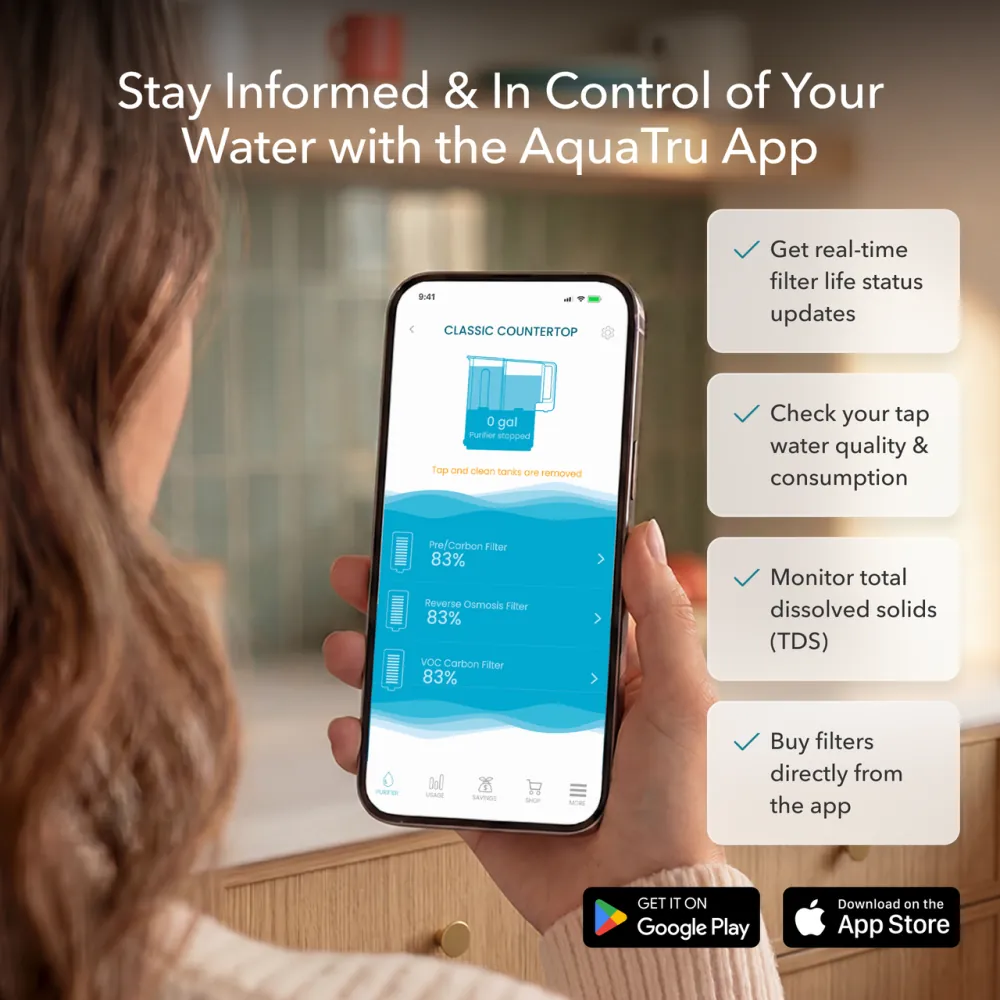
- You want the water quality reading on the machine rather than in an app.
- You want the longest warranty in the box rather than as a $49.95 line item.
- Your main worry is general taste, chlorine, dissolved solids and the headline heavy metals, all of which their sheet covers well.
- You want to spend the least today.
Buy the AquaTru Classic if
- You have a specific contaminant in mind and you want an accredited body, not a laboratory report, standing behind the claim.
- Your water report mentions pesticides, industrial solvents, disinfection by-products or pharmaceutical residue, none of which appear on the Sans sheet.
- You intend to keep the machine for years and you care that the claim has to hold on the last gallon of the filter's life, not only the first.
- You want the ability to look the product up in a public certification directory.
- You want the lowest running cost once the machine is paid for.
If you are between the two, start with your municipal water report. It is free, it is published annually, and it names the contaminants in your supply. A machine certified for 84 substances is worth the premium only if the ones on your list are among them, and the fastest way to find out is to read your own report first and the two data sheets second.
What owners report
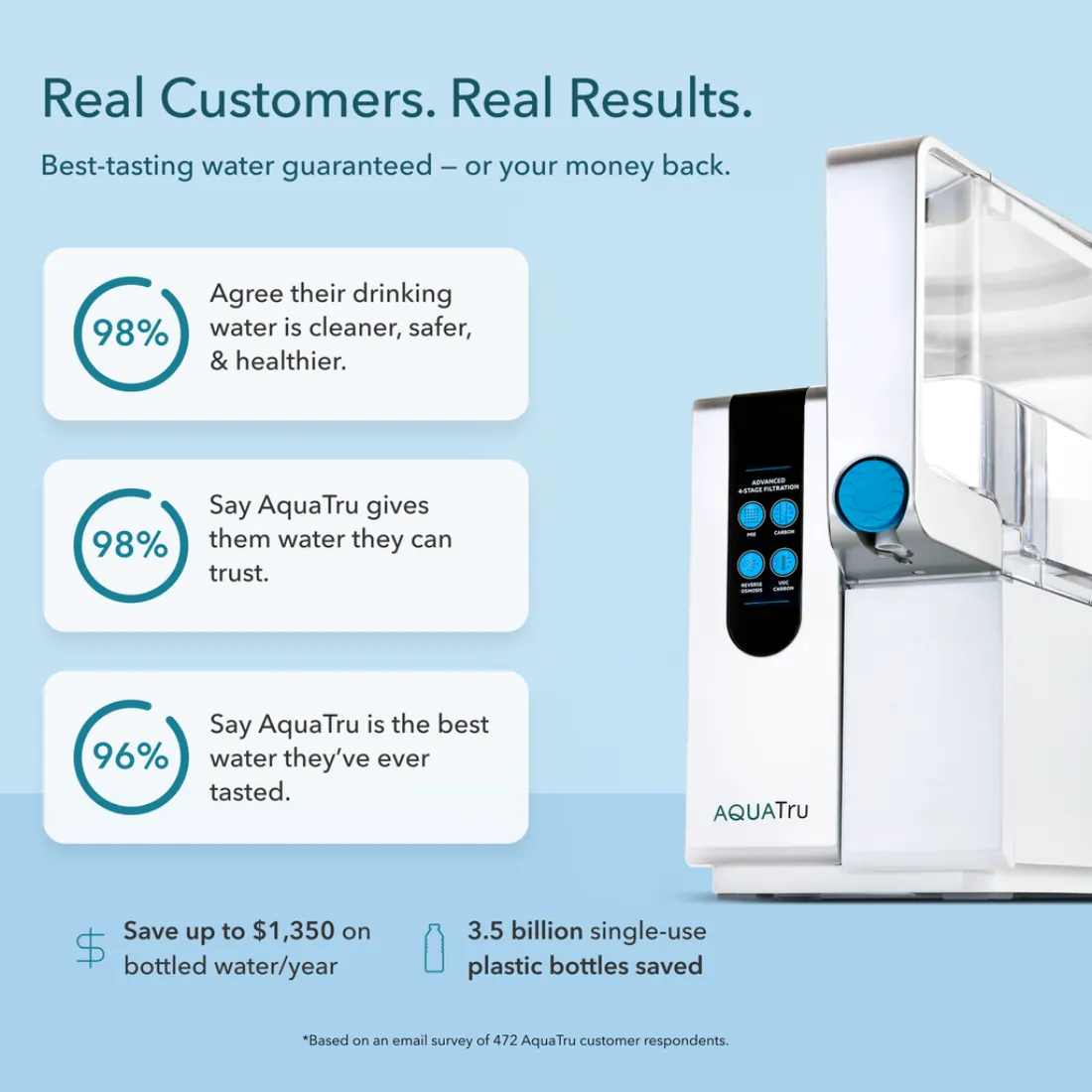
AquaTru publishes survey results from its own customers alongside its reviews.
Certification scope from the AquaTru countertop Performance Data Sheet. Customer figure and review average as published on aquatru.com on August 12, 2026.
We originally began searching for a water filter system once our local water company advised us of some chromium present in the supply. While they worked to mitigate it, we decided to get a system that could filter it out. We started with one system, but it went through filters like crazy, not financially feasible to continue using it. We landed on the AquaTru, been using it a month so far and have been really impressed with ease of use and taste/quality of the water. Super happy with it.
Keith B. · 5 out of 5, published on aquatru.com
I have had The Classic since it was introduced. I finally had to replace it because I wore it out but it is an incredibly effective machine for water purification. It takes all of the foul odors out of the tap water and it is crystal clear when the purification is complete. It is, by far, the best piece of equipment in my kitchen. I use it daily.
Alice H. · 5 out of 5, published on aquatru.com
We have a water well and did not want to commit to an under the sink reverse osmosis system just yet so this has been the perfect countertop option for us! I love the peace of mind of knowing my water is as clean as can be and the tank system works very well.
Lisa R. · 5 out of 5, published on aquatru.com
It's fast and pretty convenient that it auto filters. The button for dispensing the water is perfect compared to any other dispensing filter I've owned. It dispenses very fast and the buttons not hard to push. Only two complaints. I wish the tap water reservoir had a removable lid like the clean tank does. The hinged lid makes dumping the water and cleaning annoying. My second issue. Please use higher quality stickers. I spent 3x as long getting the warning sticker residue off the tank than I did for the rest of the setup.
CG · 4 out of 5, published on aquatru.com
Reviews are quoted as published on aquatru.com and belong to their authors. The four star review is included because a page of five star reviews tells you nothing.
Questions people ask before they choose
Does not certified mean not safe?
No. It means the performance claims have been measured by a laboratory the manufacturer selected rather than verified by an accredited certification body against a consensus standard. SGS, the lab Sans used, holds ISO/IEC 17025 accreditation. The distinction is about who sets the pass mark and who audits it over time, not about whether the measurement was competently taken.
What are NSF/ANSI 42, 53, 58, 372 and 401?
Five separate standards. 42 covers chlorine, taste and odor. 53 covers health effect contaminants, including the organic chemicals and PFOA and PFOS. 58 is the reverse osmosis standard and covers dissolved solids, lead, arsenic, fluoride, nitrate and chromium. 372 covers lead-free materials in the product itself. 401 covers emerging contaminants such as pharmaceutical residue and bisphenol A. AquaTru's countertop models are certified to all five by IAPMO R&T.
Sans publishes higher percentages on most contaminants. Is that not the whole answer?
It is a real part of the answer and it should not be waved away. It is also measured against water the company chose, by a laboratory the company selected, over one testing period, with no stated obligation about the filter's end of life or about what happens if the product changes. AquaTru's figures come with those obligations attached. Whether that trade is worth $75 is a personal call.
Which AquaTru model should I be comparing?
The Classic at $475 or the Under Sink, since those are the models IAPMO has certified. The $375 Carafe is independently tested with certification still pending, in AquaTru's own words, so comparing it to the Sans on certification grounds does not tell you anything.
Do either of these handle bacteria?
Sans publishes coliform and coliphage results and adds a UV-C stage. AquaTru publishes a 99.99 percent cyst reduction, which covers Giardia and Cryptosporidium, but no bacteria or virus figures for its countertop line. Both documents carry the same caution: neither machine is intended for water that is microbiologically unsafe without adequate disinfection.
How much water does the AquaTru Classic hold and how fast is it?
A one gallon tap water tank and a 0.75 gallon purified tank, rated at 54 gallons a day with a 75 percent efficiency rate. It needs a 120 volt socket, no plumbing, and AquaTru does not recommend it on water harder than 10 grains per gallon without softening or regular descaling.
Where to start
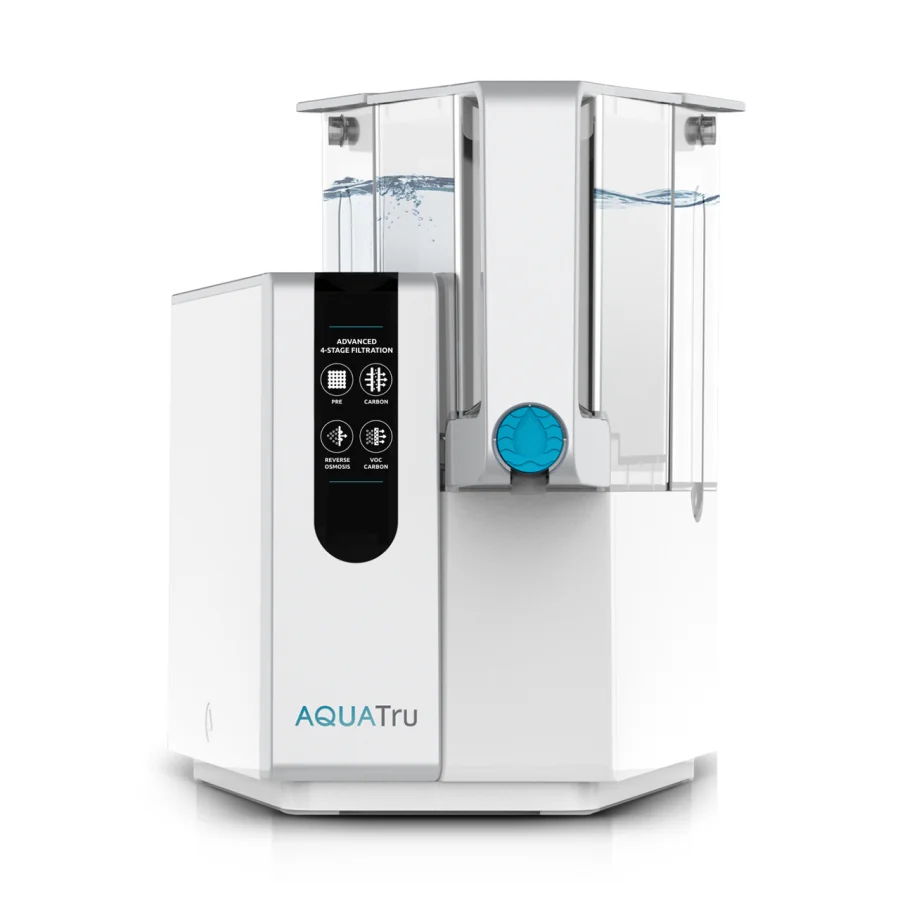 AquaTru Classic
Certified by IAPMO R&T. The model this comparison is about.
$475 · See it
AquaTru Classic
Certified by IAPMO R&T. The model this comparison is about.
$475 · See it
 AquaTru Under Sink
Also certified, no counter space, no electricity, needs installation.
From $395 · See it
AquaTru Carafe
Smallest and cheapest. Tested by IAPMO, certification pending.
$375 · See it
AquaTru Under Sink
Also certified, no counter space, no electricity, needs installation.
From $395 · See it
AquaTru Carafe
Smallest and cheapest. Tested by IAPMO, certification pending.
$375 · See it
 All four purifiers
Compare coverage, filters and certification side by side.
Full range · See them
All four purifiers
Compare coverage, filters and certification side by side.
Full range · See them
If it turns out not to be for you
AquaTru carries a 30 day money back guarantee and a one year manufacturer's warranty, with a three year extension available for $49.95. Customer service runs 24 hours a day on 1-800-220-6570. Sans carries a 30 day risk-free trial, free shipping and returns, and a three year warranty that has to be registered within thirty days of the order.
The short version
Both machines are countertop reverse osmosis and both work. Sans is cheaper, warrantied for longer, dispenses hot water, refills its own pitcher, puts the water quality reading on the front of the machine, and publishes reduction figures that are higher than AquaTru's on most shared contaminants, some of them measured against dirtier water.
AquaTru's countertop models are certified by an accredited body to five NSF/ANSI standards covering 84 contaminants, including whole categories that do not appear on the Sans sheet at all. That certification runs to the end of the filter's rated life, it is listed publicly, it has to be re-earned every five years, and the product cannot be changed without the certifier's approval. Sans states on its own data sheet that it is not NSF-certified.
One of those is a stronger machine on the counter. The other is a stronger claim on the label. Read your water report, then decide which problem you are actually solving.
See the AquaTru Classic $475 · 4.6 stars from 2,797 reviews · No plumbing · 30 day money back guarantee